
Truck
Forging a Path as We walK
We chose to cross Brazil in a 100% electric truck to test, in real-world conditions, the limits and possibilities of the energy transition in freight transportation.
The Caravana do Futuro crossed Brazil with a 100% electric truck to test, in real-life conditions, whether electrification is a viable alternative to diesel—facing sun, rain, steep slopes, and the long distances between charging points.
It was an unprecedented experiment: a way of turning discourse into practice and generating concrete data on what it truly means to move the country using clean energy.
The first 100% electric heavy-duty truck to cross Brazil.
Our travel companion was a 20-ton electric truck, consisting of a tractor unit and a 15-meter-long trailer. The tractor unit, an XCMG E7-49T, was equipped with an engine of approximately 480 horsepower and 250 kWh batteries, capable of traveling up to 150 km per charge.
The vehicle features 6×4 traction and a regenerative braking system, which recovers part of the energy during deceleration. It is a silent giant—no smoke, no noise, and plenty of torque.
With this vehicle, we tested performance, energy consumption, and charging infrastructure across very different regional realities in Brazil.
Over 102 days on the road, we crossed the country from the South to the Northeast.
The figures from this journey help illustrate what this means.
Our main learnings:
Can we give you a spoiler?
Even with limited range, the truck proved to be robust.
It traveled more than 6,000 km under varied road, climate, and terrain conditions, but the reality of Brazil’s infrastructure imposed clear limits: a lack of standardization, information, and technical support.
The Caravana had to adapt to each stretch of the route—from long distances without charging stations to irregular power levels, different payment systems, multiple apps, short cables, and low canopies that prevented the vehicle from accessing chargers.
There were 91 charging sessions along the route, carried out at charging stations operated by 16 different companies, in addition to support from various partners along the way—often requiring creativity, patience, and the help of local shopkeepers to keep moving.
Infrastructure remains the weak link in electrification
Our greatest challenge was not the truck itself, but the charging infrastructure and the power grid. Charging stations are concentrated in the South and Southeast and virtually disappear in the Northeast. From Rio de Janeiro onward, only 15% of charging sessions took place at stations with adequate infrastructure. The rest required improvised connections using portable transformers and chargers, in precarious installations—sometimes with overheating cables, outdated circuit breakers, and irregular voltage.
Average charging time ranged from 2 to 10 hours, depending on local conditions.
In many cases, the truck remained parked all day just to recharge—an operating scenario that would currently make long-distance professional freight transport with large electric vehicles unfeasible.

Electrification is possible, but still uneven
The journey confirmed the potential of electrification as a real alternative to diesel. It also made clear that access to this solution is far from equal across Brazil.
While the South and Southeast have emerging infrastructure, inland regions and the Northeast remain largely off the charging map. Without public planning and coordinated investment, the electrification of freight vehicles risks reproducing regional inequalities—contradicting the very principle of a just transition.
Energy efficiency and environmental impact
Despite the challenges, some technical results are encouraging:
The electric truck traveled 1 km consuming 1.06 kWh, while a diesel truck consumes the equivalent of 3.94 kWh per km**. Energy savings and silent operation confirm that the efficiency of electric trucks is real. At a national scale, the transition from diesel trucks to electric vehicles could generate savings of R$ 5 billion in health and environmental costs by 2050. (Source: Gigantes Elétricos).
The transition is also social and economic
Electrification is not just a technological issue.
For it to be truly just, it must include workers, ensure professional retraining, provide decent working conditions, and create new opportunities. It must also respect the rights and territories of Indigenous peoples, quilombola communities, and traditional populations.
Brazil has a clean electricity matrix and a strong industrial base, and it can lead this transformation if it invests in infrastructure, training, and integrated public policies.
Every kilometer traveled by the Caravana showed that the future of transport is not only about the type of fuel that powers vehicles, but also about people, planning, and cooperation.
Download the 100 Days on the Road report
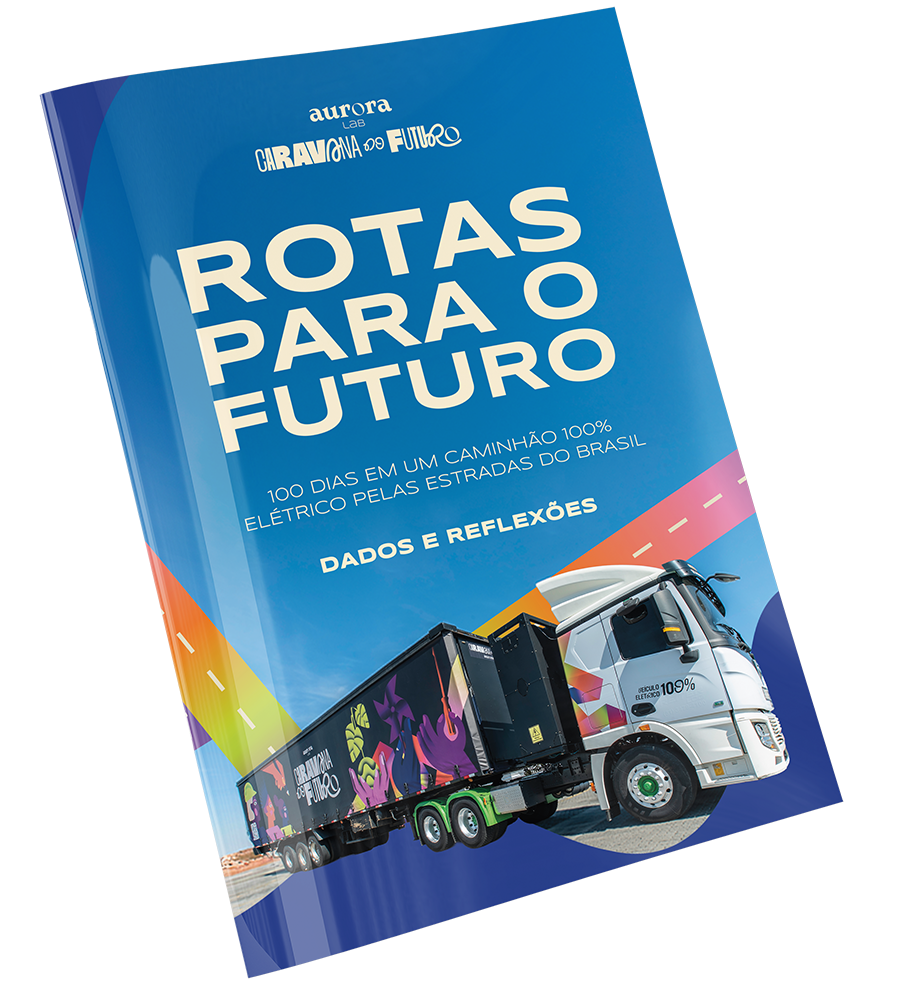
The Caravana do Futuro crossed Brazil and mapped both its bottlenecks and its potential.
The path toward electrifying heavy transport depends on investments in the power grid and charging infrastructure, system integration, and incentive policies.
That road was a school. And the data it left behind is the starting point for accelerating the transition toward a cleaner, more efficient, and fairer Brazil.
Our field team
This journey would not have been possible without the hard work and dedication of our field team, who traveled thousands of kilometers and faced countless challenges so that we can now share all these learnings.
* The calculation assumes a diesel efficiency of 2.5 km/l, resulting in a total of 2,423 liters to cover the same distance. For CO₂ emissions, a factor of 2.68 kg CO₂/l was used. This value is widely adopted and derives from the carbon content of diesel and combustion stoichiometry. Source: IPEA. https://portalantigo.ipea.gov.br/agencia/images/stories/PDFs/TDs/td_1606.pdf.
** Calculated based on road consumption and the diesel conversion factor provided by the Brazilian Ministry of Mines and Energy. https://www.mme.gov.br/SIEBRASIL/App_Content_User/archivos-publicos/nz3ggqk0.mrp20180831000000.pdf (accessed Nov 7, 2025).